Replacing asbestos roofs in commercial sheds and storage facilities is essential for improving safety, efficiency and compliance with modern building regulations. Norfoam specialises in asbestos roof replacement, providing high-quality commercial roofing solutions tailored for sheds and storage facilities.
Continue readingMaximise Comfort with Energy-Saving Insulated Roofs
Energy-saving insulated roofs transform how we experience indoor comfort and efficiency. These advanced roofing solutions regulate indoor temperatures, reducing reliance on heating and cooling systems. At Norfoam, located in North Queensland, we specialise in high-quality energy-efficient roofing designed to keep spaces cooler in summer and warmer in winter.
Continue readingTransforming Commercial Roofing with Modern Innovations
The advancements in modern roofing technology are revolutionising commercial spaces. With an emphasis on durability, energy efficiency, and cost-effectiveness, these innovations cater perfectly to the diverse needs of businesses. Upgrading to modern roofing solutions significantly enhances functionality and sustainability, ensuring a solid and long-term foundation for commercial operations.
Continue readingSustainable Building with Insulated Walling: A Smart Choice
Sustainable building practices are becoming increasingly important as industries strive to reduce energy consumption and minimise environmental impact. One of the most effective ways to achieve energy-efficient construction is through the use of insulated walling.
Continue readingBest Agricultural Roofing Solutions in North Queensland
Selecting the right roofing for agricultural sheds is crucial for protecting valuable assets such as livestock, crops and equipment. The ideal roofing solution should offer durability, temperature regulation, quick to install a nd energy efficiency to ensure optimal farm operations.
Continue readingEnergy-Efficient Insulated Roofing in North Queensland
One of the most effective ways to enhance a building’s energy performance is by investing in modern insulated roofing. These advanced roofing solutions help regulate indoor temperatures, reduce the need for excessive heating and cooling, and provide long-term savings on energy bills.
Continue readingHow Wind Ratings Reveal Australia’s Hidden Home Vulnerabilities
How Wind Ratings Reveal Australia’s Hidden Home Vulnerabilities
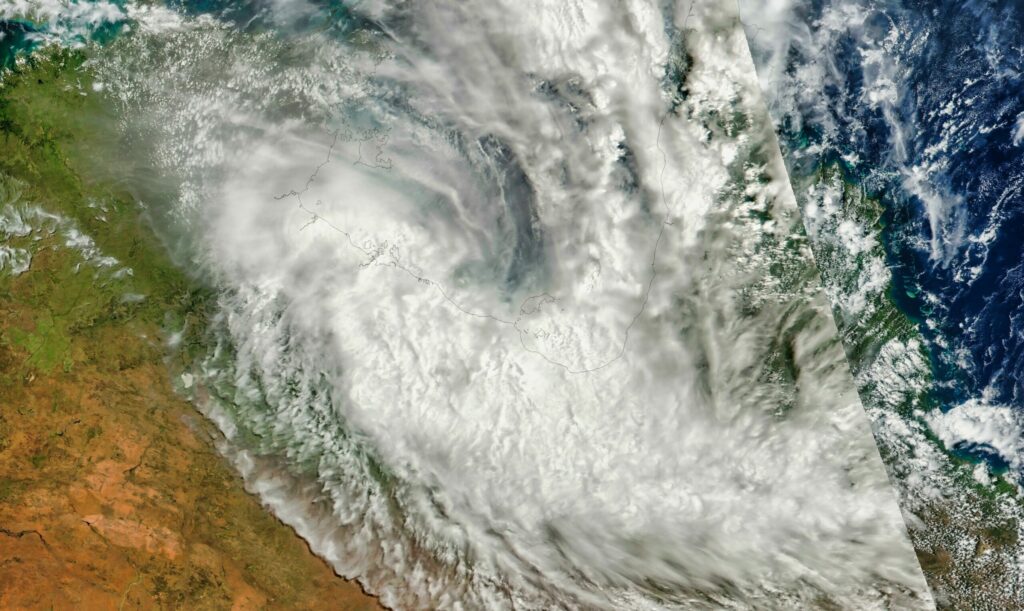
When Tropical Cyclone Alfred threatened southern Queensland and northern New South Wales in early March 2025, it sparked discussion about regional building standards, wind classifications, and home resilience, with particular focus on the structural differences between homes in Far North Queensland versus Southeast Queensland and their ability to withstand high winds.
In the wake of the cyclone, there are now calls to cyclone-proof homes as far south as northern NSW. FNQ residents, accustomed to frequent cyclones, may feel more prepared and view their homes as more resilient. But, even for those experienced with cyclones, understanding wind classifications, building resilience, and safety standards remains important for protecting property and lives.
We spoke with Rohan Madathanapalli, Business Development Manager and Technical Consultant for Bondor Metecno Group about understanding cyclone wind classifications and building codes. Norfoam is a member of the Bondor Metecno Group, Australia’s largest manufacturer of insulated panels, combining global expertise with a focus on North Queensland’s unique needs.
Can you explain Australia's wind classification system?
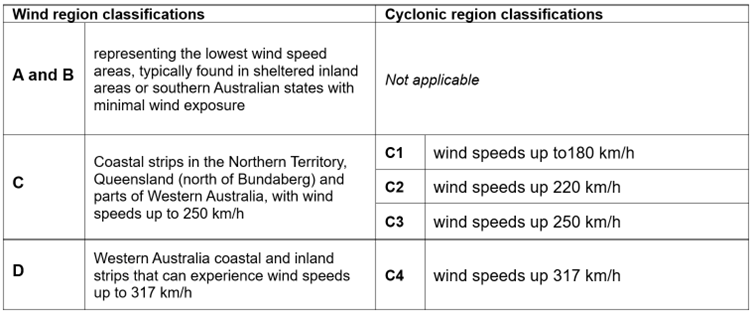
Wind classifications in Australia are a system used to indicate the design wind speed that buildings must withstand based on their geographical location and site conditions. They are categorised into wind regions and cyclonic regions classification systems that guide building design across Australia.
The key difference in classification is that wind regions provide a comprehensive framework while cyclonic regions represent a classification subset focused on cyclone-prone tropical areas.
Wind regions are categorised from A to D based on wind speed and geographical characteristics. Cyclonic regions are in Wind Regions C and D and represent the most extreme wind conditions in Australia, characterised by their vulnerability to tropical cyclones.
At a glance, these are summarised as follows:
Can you explain Australia's wind classification system?
Wind classifications reveals a home’s ability to withstand specific wind speeds, helping homeowners better understand wind resilience.
Wind resilience is fundamentally about creating a continuous, engineered path for wind forces to travel from the roof through the building’s structure and into the ground. This distributes and dissipates wind loads, preventing concentrated stress on any single point that could lead to a home’s structural failure. This approach ensures that when high winds strike, the entire building works as a unified system to resist and transfer those forces safely.
To ensure their home’s wind resilience, homeowners should understand their property’s specific vulnerabilities. They should conduct regular inspections, looking for signs of structural weakness such as rust, loose fixtures, or compromised connections. Homeowners should also secure external attachments like carports and awnings, and where appropriate install cyclone screens on windows.
For those in high-risk areas, consulting a qualified building professional is essential. They can provide detailed advice on upgrading structural elements, strengthening roof connections, bracing walls, and improving door and window frame fixings.
The goal is not just compliance, but creating a home that can withstand the increasing severe weather events driven by climate change.
Can you explain Australia's wind classification system?
- Strengthening door and window frame connections
- Installing impact-resistant screens
- Upgrading locks and hinges
- Sealing potential water entry points
- Repair structural damage
- Maintain your property’s overall condition
How do solar panels affect roofs during a cyclone?
Solar panels can significantly impact a roof’s wind resistance by increasing the surface area exposed to wind, which increases the total wind load on the roof structure, particularly uplift forces.
If solar panels or their mounting systems are not adequately designed, tested and installed, they can become detached during high winds and turn into dangerous wind-borne debris posing a risk to surrounding property and life.
The way solar panels are attached to the roof, to the battens or rafters, influences how wind loads are transferred to the underlying roof structure. Proper installation is key to circumventing any issues that may arise in cyclonic conditions.
What do builders, designers and architects need to know about wind classifications?
For builders, designers, and architects, the process begins with accurately determining the site-specific wind classification using Australian Standards AS 4055 and AS NZS 1170.2, carefully considering all environmental factors that could influence wind loads.
They must determine site-specific wind ratings, design code-compliant structures, and ensure strong resilience. This includes using wind-rated products, creating continuous load paths, and balancing performance with safety.
Builders should continuously update their knowledge of building codes, consult with structural engineers on complex designs, and stay ahead of evolving environmental challenges. This means understanding not just current standards, but anticipating future resilience requirements driven by climate change and increasingly severe weather events.
When specifying building products, builders should adopt a holistic approach that considers not just wind resistance, but also thermal performance, fire safety, acoustic requirements, material durability, and long-term environmental compatibility.
This ensures the entire building system works together seamlessly to provide comprehensive protection and performance.
What products does Bondor Metecno offer that are appropriate for achieving optimal cyclone ratings?
Bondor Metecno offers several insulated sandwich panels designed for cyclonic regions:
Nordeck® Insulated Roofing Panel – the original Nth Qld insulated panel with EPS FR core, long spanning suitable for residential and commercial applications. Tried and test for use in cyclonic regions
SolarSpan® Insulated Roof Panel – long-spanning roofing panel with an EPS FR core suitable for residential and commercial use, and tested for cyclonic regions
InsulRoof® Next Gen Corro Roof – Roofing panel with corrugated profile, EPS FR core suitable for residential applications and tested in cyclonic region
MetecnoSpan®PIR Roofing – panel with PIR (polyisocyanurate) core, suitable for commercial applications and tested for cyclonic wind regions
These panels are designed for homes and buildings in cyclone-prone areas, are tested to withstand high wind loads and comply with National Construction Code requirements.
They have been developed in collaboration with Cyclone Testing Station at James Cook University in Central Queensland and are recommended for use in Wind Regions C and D.
How do you test Bondor Metecno panels for cyclone ratings?
Panels are tested using the “Low, High, Low” cyclic testing method to validate their ability to withstand cyclonic conditions. The testing process goes far beyond simple stress evaluation.
The methodology involves subjecting panel assemblies to a carefully designed series of pressure cycles that simulate the complex wind loads experienced during a cyclone. This involves thousands of cycles at lower pressure levels, followed by hundreds at medium pressure, and concluding with a smaller number of high-intensity cycles. Each stage is monitored for potential failure indicators such as fastener pull-up, skin wrinkling, core shear, and joint failure.
This rigorous testing demonstrates that a panel system can endure both fatigue and ultimate wind loads while maintaining its critical load-carrying capacity. These tests give builders, architects, and homeowners confidence in a product’s performance under extreme environmental conditions.
Bondor Metecno’s panels are tested at the Cyclone Testing Station at James Cook University in Townsville, as well as at our own NATA (National Association of Testing Authorities) test facility at Acacia Ridge in Brisbane.
Talk to Norfoam’s technical team for wind classification advice
Norfoam is North Queensland’s only locally based manufacturer of insulated sandwich panels. We have decades of experience providing products designed to withstand the North Queensland climate.
We are a member of the Bondor Metecno Group, Australia’s largest manufacturer of CodeMark and FM-accredited insulated roofing and walling panels. With distinct core materials available to address any performance requirement across fire, thermal and long spans, our products are designed to suit Australian conditions and Australian Standards of construction.
For specific guidance on selecting wind-rated products that meet Australian building codes and wind classification requirements, contact us today for expert advice tailored to your specific project and environmental conditions.
Crafting the Perfect Cold Room: Best Practices in North QLD
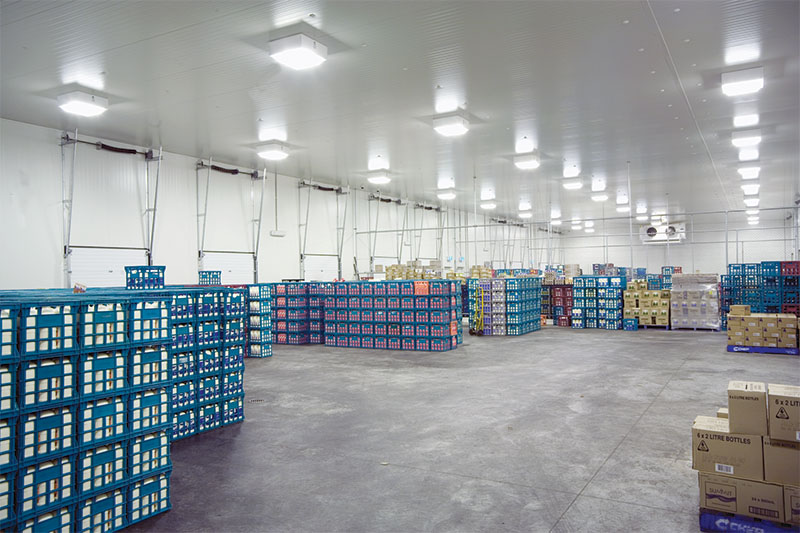
A cold room is an insulated, temperature-controlled space used across many industries like food storage, pharmaceuticals and logistics. Designing an efficient cold room is incredibly important, as proper insulation and energy efficiency contribute to performance and cost savings. At Norfoam in North Queensland, we help clients maintain temperatures in controlled environments with the best cold room design.
In this blog, we will cover the essential features and best practices for cold room installation. Learn how these crucial elements ensure the longevity, energy efficiency and performance of your cold storage solution.
Key Features of a Cold Room
When planning cold room installation, the top priorities should be high-quality insulated walls and roofing for temperature regulation. Other important features include durable door seals, ventilation and precise temperature controls. Keep in mind the insulation material should provide optimal thermal conductivity and create a moisture barrier, ensuring reliable performance and high energy efficiency. By setting up a cool room effectively, you can expect high performance and long-term results.
Best Practices for Cold Room Design
In cold room design, you should plan the layout for accessibility and energy efficiency. This means thoughtfully planning entry/exit points, with hinged, sliding or high-speed doors. Hinged doors are easy to access and seal tightly, making them the most common, although sliding doors may work in cool rooms with minimal space. Fast-opening doors in high-traffic distribution centres and warehouses reduce energy loss and temperature fluctuations.
Whichever door and layout you go with, keep in mind that updating a cold room is expensive, so you will want to consider future requirements. In terms of maintenance, routine inspections, cleaning and temperature calibration help ensure long-term functionality and performance.
Energy Efficiency and Cost-Effectiveness
Modern insulation solutions, like those offered by Norfoam, minimise energy consumption and offer sustainability benefits through a reduced carbon footprint. A properly insulated cool room will have fewer temperature fluctuations and rely less on energy systems, minimising thermal bridging and keeping costs under control. An Energy Star-rated refrigeration system, LED lighting and automatic door closers may lower energy consumption and operational costs as well.
Conclusion: Making the Most of Cool Room Design
From food storage in restaurants to product control in factories, cold rooms play an important part in Australian industries. Norfoam stands by the critical role of superior insulation and thoughtful design in achieving a reliable, efficient cold room. If you’re looking for controlled environment solutions for cool room equipment, our experienced team can guide you towards the optimal layout, design and energy efficiency. With the right insulation and ventilation, you will be well on your way to installing a reliable, long-lasting cold room.
Choose Superior Cool Room Insulation in North QLD
We hope these insights help you when planning cool room equipment and design. We encourage you to contact our trusted Norfoam team for expert guidance and premium cold room solutions tailored to your needs. Enquire about cold room insulation online today and look forward to proven solutions for controlled environments in North Queensland.
Enquire about Norfoam's cold room insulation products
Future of North QLD Energy-Efficient Building: Insulated Solutions
Insulated solutions are featured in most modern energy-efficient building designs, playing a key role in reducing energy consumption and environmental impact. At Norfoam, we supply high-quality insulated walling and roofing to our clients for a wide range of building projects across the residential, commercial and industrial sectors. We are proud to play a part in enhancing environmental responsibility with building materials that are better for the world around us. Let’s take a closer look at the future of insulated, energy-efficient buildings in North Queensland.
Advancements in Insulated Technology
Innovations in insulated roofing and walling are shaping sustainable construction practices. While traditional insulation did the job back in the day, it left a lot to be desired in terms of renewable resources, health impacts and overall performance over time. Now, fibreglass, foam board and spray foam are being replaced by enhanced walling and roofing with insulation made from EPS-FR core and BlueScope COLORBOND® skins. This new-and-improved insulation provides better thermal performance with less impact on the environment.
Energy Efficiency Benefits
Insulated walling and roofing solutions minimise heat transfer, reduce energy bills and create comfortable indoor spaces. All these benefits are especially beneficial in North Queensland, where the weather is hot and humid and every little bit of thermal protection counts. From insulated wall panels to an insulated patio roof, every addition blocks heat gain and keeps cool, climate-controlled air inside where it belongs. It’s all part of smart, sustainable modern building across residential and commercial developments.
Environmental Impact
Energy-efficient buildings help lower energy usage and household bills while also lessening the impact on the environment. More and more builders, architects and developers are embracing the eco-friendly nature of insulated solutions, such as reduced carbon emissions and sustainable materials. For homes and businesses that are built to last and designed with the environment in mind, insulated solutions are the way to go.
Versatile Applications for Insulated Building Materials
For a healthier, greener world, insulated buildings are a must. These solutions can be adapted to various projects, from an insulated patio roof at home to insulated walls in commercial buildings and controlled environments. Effective insulation reduces heat transfer, regulates temperatures and prevents air leakage for comfortable living and working spaces.
Conclusion: Why Choose Insulated Solutions For Your Next Build
Insulated roofing and walling are the way of the future. Their value in terms of sustainability and performance makes them the right choice for residential, commercial and industrial applications. From new homes or renovations where families will appreciate lower energy bills, to shops and restaurants where sustainability is a key focus, insulated solutions make perfect sense. It’s an investment in the future and a proven way to minimise environmental impacts while optimising energy efficiency and thermal performance.
Explore Insulated Roofing and Walling in North Queensland
As you can see, there are many advantages of energy-efficient buildings in North Queensland. You can count on Norfoam for premium insulated solutions tailored to your needs. Enquire about roofing with insulation and look forward to our excellent service and unrivalled craftsmanship.